
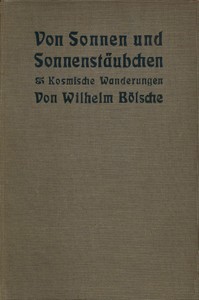
Von Sonnen und Sonnenstäubchen : Kosmische Wanderungen by Wilhelm Bölsche
First published in 1914, Wilhelm Bölsche's Von Sonnen und Sonnenstäubchen is not a novel with a plot in the traditional sense. Instead, think of it as a guided tour of the universe, with Bölsche as your wildly enthusiastic and knowledgeable friend. He wrote this during a golden age of discovery in astronomy and physics, and he was determined to bring that excitement to everyone.
The Story
The 'story' is the story of everything. Bölsche begins by inviting you to contemplate the vastness of space and the countless suns (stars) within it. He then walks you through the life cycle of a star, explaining the science of how they form, shine, and eventually fade. But the magic happens when he zooms in on the 'Sonnenstäubchen'—the 'sun-motes' or cosmic dust. This isn't just space junk; Bölsche argues this dust is the fundamental building block of planets and, ultimately, life itself. The narrative flow connects the cataclysmic death of a giant star to the gentle drift of dust clouds that, over eons, coalesce into new worlds. It's a continuous cycle of creation and destruction written on a galactic scale.
Why You Should Read It
What makes this book special is Bölsche's voice. He isn't a cold lecturer; he's a storyteller in love with his subject. He makes you feel the sheer scale of cosmic events while also highlighting our intimate connection to them. When he describes how the iron in your blood was forged in the heart of a long-dead star, it’s not just a scientific fact—it's presented as a profound and beautiful truth. He tackles big, scary ideas (like the heat death of the universe) with a sense of wonder rather than dread. Reading this feels like having your mind expanded page by page. You finish it not feeling small, but feeling like a part of something magnificent and ongoing.
Final Verdict
This book is perfect for curious minds who enjoy authors like Carl Sagan or Neil deGrasse Tyson, but want to see where that tradition of poetic science writing began. It's for the reader who loves history of science, beautiful prose in translation, and big ideas that make you look at the night sky differently. Be prepared for some dated science (it's over 100 years old, after all!), but read it for the breathtaking perspective and the infectious joy of discovery. It’s a cosmic hug from the past.
You are viewing a work that belongs to the global public domain. Use this text in your own projects freely.
Sarah Lee
1 month agoHaving explored several resources on this, I find that the structural organization allows for quick referencing of key points. I'm glad I chose this over the other alternatives.
Kimberly Thomas
2 years agoI appreciate how this edition approaches the core problem, the clarity of the writing makes even the most dense sections readable. This has become my go-to guide for this specific topic.
Mary Harris
7 months agoUnlike many other resources I've purchased before, the objective evaluation of the pros and cons is very refreshing. Simple, effective, and authoritative – what else could you ask for?
Melissa Allen
1 year agoHelped me clear up some confusion on the topic.





James Jones
6 months agoI found the author's tone to be very professional yet accessible, the critical analysis of current industry standards is very timely. The insights gained here are worth every minute of reading.