
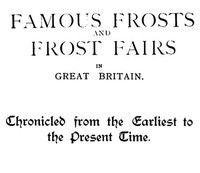
Famous Frosts and Frost Fairs in Great Britain by William Andrews
The Story
This isn't a novel with a plot, but a collection of true stories centered on one incredible phenomenon: the freezing of the River Thames. William Andrews acts as your guide, walking you through the most severe winters in British history, from the 1600s to the early 1800s. He focuses on the famous "Frost Fairs," the spontaneous festivals that erupted on the thick ice. The book shows how London's main artery turned into a carnival ground, complete with streets of stalls, roasting oxen, games of football, and even souvenir printers churning out certificates to prove you were there.
Andrews builds the narrative from firsthand accounts. You'll read about King Charles II visiting the fair, about opportunistic vendors, and about the constant, underlying fear of the ice giving way. The story culminates with the last great frost fair of 1814, after which changes to the river's bridges and flow meant it never froze so completely again.
Why You Should Read It
I picked this up expecting a dry list of weather events, but it's so much more human than that. Andrews has a knack for finding the vivid details that make history feel immediate. You can almost hear the creak of the ice and smell the roasting chestnuts. What I love is how it captures human nature in a crisis—or in this case, a deep freeze. Faced with a total disruption of normal life, people didn't just huddle inside; they created a whole new, temporary world of commerce and entertainment on the riverbed. It's a brilliant snapshot of resilience, community, and sheer opportunism. The book also quietly shows how we've changed our environment; the fact that the Thames doesn't freeze like this anymore is a story in itself.
Final Verdict
Perfect for history buffs who prefer their facts served with personality, or for anyone who enjoys those "weird history" podcasts. It's also a great fit for London enthusiasts—you'll never look at the Thames the same way again. Because it's written in a clear, reportorial style from the late 1800s, it feels like a curated museum exhibit in book form. It’s not a difficult read, but it is packed with fascinating snippets that make you stop and think, 'Wait, that really happened?' If you've ever been curious about the stranger chapters of Britain's past, this is a delightful and eye-opening deep dive.
This is a copyright-free edition. You are welcome to share this with anyone.
Margaret Taylor
7 months agoThe methodology used in this work is academically sound.
Aiden Davis
1 year agoThe fonts used are very comfortable for long reading sessions.



Sarah Martinez
1 month agoMy first impression was quite positive because the author manages to bridge the gap between theory and practice effectively. The price-to-value ratio here is simply unbeatable.