
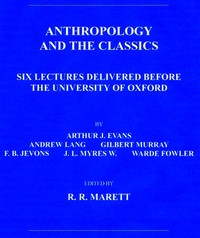
Anthropology and the Classics by Evans, Fowler, Jevons, Lang, Murray, and Myres
Published in 1908, this book is a snapshot of a big idea at a specific moment in time. It's a collection of six lectures given at Oxford University. Each chapter is written by a different expert—people like Arthur Evans (who would soon excavate Knossos) and Gilbert Murray (a famous Greek scholar). They were all asking the same question: what happens when we stop treating classical texts as purely literary works and start examining them with the tools of the new social sciences?
The Story
There isn't a single narrative plot. Instead, think of it as a roundtable discussion. Each scholar takes a turn. One might examine the story of the Minotaur, not as a monster tale, but as a possible memory of bull-worship rituals. Another looks at the funeral games in Homer's Iliad and asks if they reflect real, early Greek social customs. Another compares gods from different cultures to see how ideas travel. The 'story' is the collective argument: that the worlds of Greek myth and early Roman history are packed with social clues that earlier scholars missed because they were only looking for beautiful poetry or political lessons.
Why You Should Read It
What's thrilling is the sense of possibility. These writers are like kids with a new toolbox, eager to take apart the clockwork of the ancient world to see how it really worked. They're confident, sometimes a bit over-enthusiastic, and you can feel the excitement of a new academic frontier. You don't have to agree with all their conclusions (some are pretty dated now) to appreciate their boldness. It reframes the classics not as static, perfect monuments, but as living records of human societies that changed over time. It makes Achilles and Odysseus feel less like distant heroes and more like products of a specific, recoverable world.
Final Verdict
This isn't a casual beach read. It's a serious, slightly academic book from over a century ago. But it's perfect for a specific reader: the history or classics fan who wants to see how our understanding of the past gets built. It's for the person who enjoys seeing scholars think out loud, make connections, and sometimes stumble. If you've read Mary Beard or Edith Hall and want to see some of the earlier, grittier work that helped shape modern classical studies, this is a fascinating time capsule. Read it to engage with the arguments, not for final answers.
There are no legal restrictions on this material. Knowledge should be free and accessible.
Donald Davis
2 weeks agoI started reading this with a critical mind, the case studies and practical examples provided add immense value. If you want to master this topic, start right here.
Donald Lee
2 years agoHaving explored several resources on this, I find that the data points used to support the main thesis are quite robust. If you want to master this topic, start right here.
David Martin
4 months agoGiven the current trends in this field, the inclusion of diverse viewpoints strengthens the overall narrative. I'll be recommending this to my students and colleagues alike.
Sandra Garcia
2 months agoFast paced, good book.



Jennifer Williams
1 month agoWhile browsing through various academic sources, the level of detail in the second half of the book is truly impressive. I'm genuinely impressed by the quality of this digital edition.