
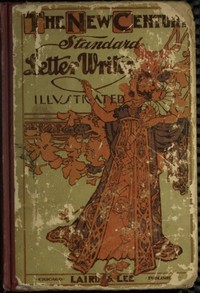
The New Century Standard Letter-Writer by Alfred B. Chambers
Let's be clear from the start: this is not a book you read for plot. 'The New Century Standard Letter-Writer' is a time capsule disguised as an instruction manual. Published in 1901 by Alfred B. Chambers, it's a collection of sample letters intended to guide Americans through the complex social etiquette of the day. It’s organized by life events, offering pre-written templates for moments big and small.
The Story
There's no narrative. Instead, you flip through chapters like 'Domestic Letters,' 'Business Letters,' and 'Letters of Friendship and Society.' Each page presents a scenario. A young man needs to write to his sweetheart's father for permission to court her. A woman must delicately ask for the return of a borrowed book. A store owner has to apologize for sending the wrong order of corsets. The 'story' is in the cumulative picture these letters paint—a society obsessed with propriety, where every interaction, even the most personal, followed a strict script. The drama is all implied: the heartache behind the formal rejection letter, the quiet desperation in a request for a loan, the gossip simmering under a polite inquiry about a neighbor.
Why You Should Read It
I loved this book because it’s unexpectedly human. The rigid formulas are funny at first (there's a whole letter on how to address a Duke), but then you stumble on a sample letter from a parent mourning a child, or a farmer writing home about failing crops. The emotion pushes against the formal language, and that's where it gets powerful. It shows us that while the rules of communication were different, the feelings weren't. Our need to connect, to apologize, to love, and to grieve is all there, just wrapped in more layers of ceremony. It makes you think about our own 'etiquette' today—our texting abbreviations and email sign-offs—and what future readers might make of them.
Final Verdict
This is a perfect little book for history lovers, writers looking for period detail, or anyone who enjoys quirky primary sources. It’s not a cover-to-cover read; it’s a book to dip into for ten minutes at a time, each visit offering a tiny, perfectly preserved scene from everyday life over a century ago. If you've ever wondered how people navigated awkward conversations before the 'unsend' button, this is your answer. It’s a charming, often poignant, reminder that the art of putting feelings into words has always been a tricky, beautiful struggle.
This text is dedicated to the public domain. Share knowledge freely with the world.
Susan Rodriguez
2 months agoThe information is current and very relevant to today's needs.
Paul Jackson
9 months agoGiven the current trends in this field, the evidence-based approach makes it a very credible source of information. It’s a comprehensive resource that doesn't feel bloated.
Noah Johnson
1 year agoVery helpful, thanks.
Barbara Anderson
3 months agoVery interesting perspective.




George Rodriguez
1 year agoHaving explored several resources on this, I find that the wealth of information provided exceeds the average market standard. It definitely lives up to the reputation of the publisher.