
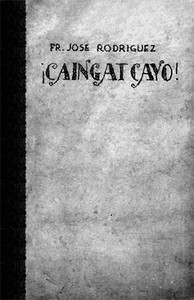
¡Caiñgat Cayo! by Fr. José Rodriguez
Let's set the scene. It's 1718 in Manila. A book hits the streets with a startling title: ¡Caiñgat Cayo! ('Beware!'). The author is listed as Don Pablo Clain. But almost everyone knew—or soon found out—that the real writer was Father José Rodriguez, a Jesuit friar. He used a pseudonym, which immediately makes you ask: what's in this book that required a disguise?
The Story
The book itself is a religious and political commentary. Rodriguez wrote it in the wake of a previous bloody Chinese uprising in Manila. His main argument was a warning: he believed the local Chinese community (called Sangleys) were planning another revolt, and the Spanish authorities weren't taking the threat seriously enough. He urged vigilance and stronger defensive measures. But the act of publishing it under a false name turned the content into something else entirely. It became an act of defiance, a document so provocative the author felt he couldn't put his real name on it. The Spanish government was furious, confiscated copies, and Rodriguez faced serious consequences for his unauthorized and secretive publication.
Why You Should Read It
What grabs me isn't just the historical warning. It's the sheer, bold nerve of it. Here's a man inside the system, using his position and education to sound an alarm, but having to mask himself to do it. Reading ¡Caiñgat Cayo! feels like holding a piece of contraband. You're not just reading his arguments about Chinese and Spanish tensions; you're witnessing a person risk his safety to be heard. The pseudonym 'Clain' isn't a footnote—it's the heart of the drama. It makes every line feel charged with a double meaning, a hidden layer of protest beneath the surface-level warning.
Final Verdict
This is a niche but fascinating read. It's perfect for history buffs who love primary sources that read like political thrillers, and for anyone interested in the complex, often hidden, currents of colonial Philippines. It's short, but it's dense—more of a historical artifact to be studied than a casual narrative. If you enjoy unpacking the 'why' behind a document—why it was written, why it was hidden, why it caused an uproar—then Father Rodriguez's disguised warning is a compelling piece of the puzzle.
This text is dedicated to the public domain. You are welcome to share this with anyone.
Jessica Wright
1 year agoFrom the very first page, the author's voice is distinct and makes complex topics easy to digest. A valuable addition to my collection.
Liam Garcia
8 months agoClear and concise.
Richard Garcia
1 year agoHaving read this twice, it manages to explain difficult concepts in plain English. Worth every second.
Kimberly Davis
2 years agoVery interesting perspective.
Paul Hernandez
2 months agoI had low expectations initially, however it challenges the reader's perspective in an intellectual way. A true masterpiece.