
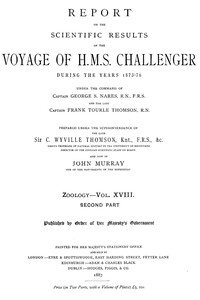
Report on the Radiolaria Collected by H.M.S. Challenger During the Years…
Let's be clear from the start: this is not a book you read cover-to-cover like a thriller. ‘Report on the Radiolaria’ is a monumental scientific catalog, the result of the first truly global oceanographic expedition. From 1873 to 1876, the HMS Challenger sailed the world, and its crew collected samples of deep-sea life from hundreds of stations. Among the haul were countless specimens of Radiolaria—microscopic, single-celled organisms with stunningly complex silicate skeletons.
The Story
There isn't a plot in the traditional sense. The ‘story’ is the process of discovery itself. The book is Haeckel’s attempt to bring order to an overwhelming amount of new data. He describes, names, and classifies over 4,000 new species. He groups them not just by scientific family, but by the incredible geometric patterns of their shells—stars, spirals, lattices, and crowns. The narrative tension comes from watching a brilliant mind try to fit the boundless creativity of nature into a logical system. It’s about looking into the abyss and finding not monsters, but architecture.
Why You Should Read It
You read this for the awe. Haeckel was a scientist, but he was also an artist. The hundreds of lithographic plates in this book are not just diagrams; they are works of art. Seeing these intricate, otherworldly forms makes you realize how much of our planet’s beauty is invisible to the naked eye. Haeckel believed these tiny creatures proved the interconnectedness of all life, and his passion bleeds through the dry scientific prose. Flipping through the pages, you feel like you’re peeking over his shoulder as he discovers a new universe in a drop of water. It’s a humbling reminder of how much we didn’t know, and how much wonder there still is to find.
Final Verdict
This is a book for the curious and the patient. It’s perfect for art lovers fascinated by natural patterns, for science history fans who want to witness a foundational moment in biology, or for anyone who needs a dose of pure, unadulterated wonder. Don’t try to memorize the Latin names. Just browse the illustrations, read a few of Haeckel’s descriptions, and let yourself be transported. It’s a portal to a time when the deep sea was the final frontier, and a single microscope could reveal its greatest treasures.
This title is part of the public domain archive. Use this text in your own projects freely.
David Moore
1 month agoI appreciate how this edition approaches the core problem, the emphasis on ethics and sustainability within the topic is commendable. If you want to master this topic, start right here.
Ashley Moore
1 year agoHaving explored several resources on this, I find that the visual layout and supporting data make the reading experience very smooth. The insights gained here are worth every minute of reading.


Linda Martinez
2 months agoUnlike many other resources I've purchased before, the cross-referencing of different chapters makes it a great study tool. This adds significant depth to my understanding of the field.