
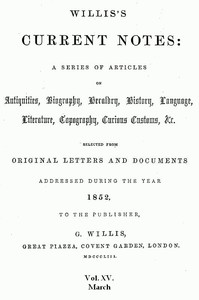
Willis's Current Notes, No. 15, March 1852 by George Willis
Let's be clear: this isn't a novel. 'Willis's Current Notes, No. 15, March 1852' is a single monthly issue of what we'd now call a periodical or a specialist magazine. Compiled by a George Willis (though often catalogued as 'Unknown'), it's a collection of letters, queries, and short articles sent in by the public. There's no traditional narrative. Instead, the 'story' is the conversation itself.
The Story
Imagine opening a magazine where readers debate the authenticity of a ghost story from Kent, another asks for the chemical composition of a new dye, and someone else wants to settle a bet about the oldest oak tree in Surrey. That's this book. It jumps from archaeology to household hints to folklore without warning. One page is a serious discussion on preserving ancient manuscripts, the next is a heated argument about the best breed of dog for ratting. It's the intellectual and casual chatter of 1852, unfiltered and unedited.
Why You Should Read It
This is where the magic happens. Reading this isn't about learning big historical facts; it's about feeling the texture of daily life. You get a sense of what ordinary, curious people cared about. Their fears (hauntings), their pride (local history), their practical problems (stains on furniture). The anonymity of the contributors makes it even better—you're hearing voices, not famous names. It completely shatters the stiff, formal image we often have of the Victorians. These people were just as nosy, opinionated, and eager to solve mysteries as we are.
Final Verdict
This is a niche read, but a deeply rewarding one. It's perfect for history lovers who are bored with kings and battles, for writers seeking authentic period detail, or for anyone who enjoys the strange charm of old newspapers and forgotten archives. It's not a page-turner in the usual sense, but it is an incredible portal. You don't just read about 1852; for a few brief, scattered moments, you feel like you're living in it, listening in on the chatter at the back of a smoky London coffeehouse.
This content is free to share and distribute. Enjoy reading and sharing without restrictions.
Patricia Hernandez
11 months agoMy professor recommended this, and I see why.







Christopher Anderson
11 months agoThis is now a staple reference in my professional collection.